
With 2025 in rear view
Dear All,
Looking back at 2025, it is hard to believe the year contained only 365 days. The sheer velocity of news and global events was unlike anything we have experienced before.
We began the year with President Trump’s return to 1600 Pennsylvania Avenue and a comprehensive list of policy changes. Geopolitical tensions escalated significantly, including U.S. strikes on Iranian nuclear production sites. It was also a year defined by a surge in AI development, major shifts in global trade and tariffs, and the expanded use of GLP-1 medications to improve broader human health. We had extreme weather events, massive earthquakes, and cultural shifts like Gen Z movements based on increasing youth unemployment and the affordability crisis. The Roman Catholic Church selected an American Pope to lead the world’s faithful (there were 267 Popes so far and none from North America). The stock markets were up, private markets got popular, precious metals were in demand, the Louvre was robbed, and Taylor Swift got engaged to Travis Kelce.
Everything seems to be in transition. From adjusting to the speed of technological evolution to finding a new leadership balance post-Pax Americana, the world is in transition. We expect 2026 to be a continuation of the themes established last year. We anticipate ongoing volatility driven by economic data shifts and the perceived impact of new policies.
Overconcentration is continuing, with investors on the edge of their seats trying to decide when to rotate into more traditional sectors. Deregulation would bring on even more deals on Wall Street, continuing the M&A and IPO momentum. Geopolitics in rebalance continue to be the big story in the news and current wars continue, with new ones starting. The new US foreign policy will be taking its full shape, and we could be seeing the Chinese, Iranian, and European responses forming, with Russian being clear. Despite it all, we still suggest optimism and have a cautiously positive outlook like we did in the previous year.
Macro outlook and geopolitics should be viewed through the prism of the dominance of the US and Chinese economies, which are having an increasing role in the success or failure of the world balance and prosperity. The relationship between these superpowers and the willingness to maintain communication and strategic balance allowing for their mutual prosperity is, at this point, the key to global stability and growth. To maintain its superpower status, both are positioning to secure their access to unlimited sources of energy, a long-lasting supply of rare materials, and cutting-edge technology.
This confirms a shift I have discussed since 2012: the move from globalization to a world of “superblocks,” where nation-states use economic and military influence to create connected security blocks. We now live in a new geopolitical reality, and investors should be adjusting their axioms and their expectations as we did a few years back.
Wealth Concentration peaked globally between 1900 and 1910, with the wealth of the top 10% of property holders owning 94% of the wealth of the richest state and the largest empire on the planet. Indeed, the top 1% held 70%. This all-time historic high was challenged by the birth of populist national movements in Europe and elsewhere across the colonies. Ultimately initiating World War I that led to major shifts in world order, creation of new states, major life and asset loss, re-division of the remaining wealth, the Great Depression, and ultimately caused World War II.
Along with the long-term borrowing ability of developed nations, we continue to have long-term concerns with the wealth concentration trend continuing its rise. The share of the US wealth pie owned by the top 0.1% grew 59.6% from 1989 to 2024, according to the Institute for Policy Studies analysis of Federal Reserve data, while the share of the bottom 50% of households has declined 26.1%, adjusted for inflation. Since 1989, the richest 1% have seen their household wealth more than quadruple from $11.74 trillion to $50 trillion at the end of 2024. Their share of the $162 trillion US wealth increased from 23% in 1989 to 30.9% in 2024, a 34.4% increase.
Labor could be the key factor in 2026 economy. We are now at 4.6% unemployment rate, and we may move to 5% to 6% in the next year (could be hidden by the current immigration policy and no-visa regime). Firms are in a no-hire mood. Words like housing crisis and affordability could be mentioned even more with real wages declining. This could cause some deflation, which should convince the Fed hawks to agree to further cuts in short-term rates. Stock markets would react positively to those cuts, likely to create even larger wealth concentration. If the labor issue proves to be structural rather than cyclical (a jobless boom due to increased productivity), Fed alone cannot cure this problem.
We are counting on continued capital spending, high levels of consumption, the continuation of no-hire-no-fire employment, and further easing by the Fed. If any of the three main factors falter, our positive outlook would face serious challenges.
AI technology and its implementation continue to be one of the themes we are focused on. Global AI infrastructure market is on track for unprecedented growth, poised to surpass $200 billion in spending by 2028, according to the latest findings from the International Data Corporation. The estimate for this year now sits at $109 billion. With hyperscalers AI spending estimated at $376 billion in 2025 and expected to grow to $453 billion in this year (FactSet Consensus Data), Morningstar Equity Research views the group as fairly valued overall while reflecting different upside and downside scenarios, with many stocks in 3-star territory—the middle of the Morningstar rating range.
Additionally, valuations are also well below levels seen in prior bubbles (Top tech firms are trading at a 12-month forward multiple of 30 times, while leading tech names were trading at a multiple of over 70 times in 1999—UBS). The current economic conditions and monetary policy are also benign now, with rates falling and the economy being relatively resilient.
Using historical comparison could be valuable in forming opinions about the AI buildout boom or bust.
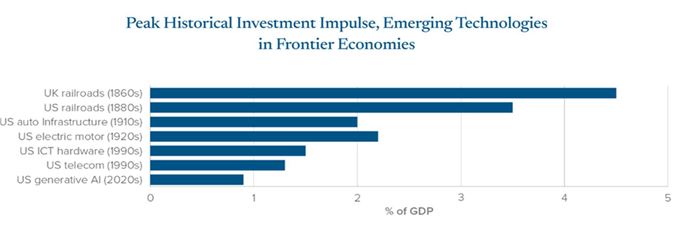
Historically, infrastructure investment impulses have generally peaked at 2%–5% of GDP. Electrification and the 1990s IT boom peaked at about 1.5%–2.0% of GDP. By contrast, AI investment in the US over the past year remains below 1% of GDP, a large but not outsized impulse by historical standards (Mackenzie Investments).
Hyperscalers and semiconductor producers were the only ones participating in AI profit growth so far. They are working on increasing their capacity and may even be forced to ditch their asset-light strategy. On average, asset-light companies outperformed their asset-heavy peers by four percentage points in the last five years of total shareholder returns (Ernst & Young). This strategy is no longer used only by hyperscalers (Marriott, for example, permits owner-investors to operate under their brand while collecting a fee. This allows the hotel company to sell more stock, finance operations, use capital for short periods of time, reduce volatility, and expand their offerings). It is likely that the fear of falling behind in the AI race is larger than the fear of the high-capital-investment/high-asset business model.
We should be monitoring the return on equity of these companies in the future. Their ability to hoard cash and buy back their stock in market pullbacks may become very limited. The spread of profitability growth into industrials, financials, and software may be coming soon. It is good that people are concerned about valuation and cautious about the ability to maintain this level of growth. It makes for a good market to invest in, even with expectations of volatility.
Focus on quality is another theme for us in 2026. Some of the best-performing stocks in 2025 were of companies that are yet to show profitability. At now-higher valuations, the likelihood of this repeating is small. With small businesses hurting from adjustment to trade taxes, concerns about employment numbers going forward, and a chance of consumer spending slowing, companies with a proven return on equity, earnings growth, and stable dividends are presenting not only more safety in volatile times but also show more potential with their lower valuation multiples.
Looking for quality companies also extends internationally. International equities have in 2025 outperformed US equities by the largest margin since 2013 in US dollar terms (JP Morgan). In the first quarter of 2025, stocks of emerging Europe increased by 17%. In the second quarter, South Korea and Taiwan recorded a 28% performance. Then outperformance shifted to China and South Africa in the third quarter, where stocks increased around 20% in each market (Goldman Sachs). It was good to participate in this valuation catch-up, and with projected GDP growth globally, earnings per share expected to be larger than in the US, and the dollar continuing to be weaker, international companies could help with performance and diversification.
The financial sector continues to be of interest, with 2025 seeing more than 150 bank deals announced with combined assets exceeding those of 2024 and 2023 put together (Reed Smith), and with the eight US Globally Systemically Important Banks having $155 billion in surplus capital in late 2025 (Bloomberg Professional Services). The upcoming Basel III Agreement, with expectation of closing in 2026, explicitly states the reduction of the CET1 capital increase requirement for the largest banks to 0%, down from the original proposal of 19% (The US Fed, Global Banking Finance Review). With the yield curve normalizing and deregulation continuing, potential for financial stocks still looks good.
Bonds—which were an asset class out of favor in the very low-rate environment until the corona crisis, back in favor for a short period of time, and then out of favor again with rising interest rates—are once again a good way to diversify portfolios and create quality income. With the yield curve normalizing, the resilience of the 10-year treasury yield, and expectations of at least some further rate cuts by the Fed, bonds could add to performance with stabilization of portfolios at times of volatility in the next year. Municipal bonds could be especially interesting at current valuations and beneficial after-tax yields.
2025 was a year of transition, marked by major political shifts, escalating geopolitical conflicts, surge in AI development, reshaped global trade, and a technological revolution in health. It was a volatile but ultimately a very good year for global markets. As we enter 2026, we expect continuation of volatility, driven by a new U.S. foreign policy, divisions in domestic politics, and a global rebalancing of superpowers that requires investors to adjust their long-standing expectations. While wealth concentration and high-tech valuations present long-term concerns, we remain optimistic, focusing our strategy on "quality" companies with proven earnings, stable dividends, and attractive international opportunities. By leveraging a normalizing yield curve through financials and fixed income, we aim to navigate this "superblock" reality with a disciplined approach to diversification, income generation, and risk management.
Emir Culov, MBA
Partner, Culov Wealth Management
Portfolio Management Director
Any opinions are those of Emir Culov and not necessarily those of Raymond James. Expressions of opinion are as of this date and are subject to change without notice. The information has been obtained from sources considered to be reliable, but we do not guarantee that the foregoing material is accurate or complete. Any information is not a complete summary or statement of all available data necessary for making an investment decision and does not constitute a recommendation.
Past performance may not be indicative of future results. Future investment performance cannot be guaranteed, investment yields will fluctuate with market conditions. Investing involves risk and you may incur a profit or loss regardless of strategy selected, including asset allocation and diversification. Every investor's situation is unique and you should consider your investment goals, risk tolerance and time horizon before making any investment. Prior to making an investment decision, please consult with your financial advisor about your individual situation.
The S&P 500 is an unmanaged index of 500 widely held stocks that is generally considered representative of the U.S. stock market. Keep in mind that individuals cannot invest directly in any index, and index performance does not include transaction costs or other fees, which will aect actual investment performance. Individual investor's results will vary.
