
The Reasons For Exiting China
Dear All,
For many years now we have kept our exposure to China low. Over the last year our portfolios have effectively exited Chinese public equities and replaced them with other emerging markets equities instead. The decision not to participate (for now) in future growth of this very important world market was not taken lightly. We have been tracking data on Chinese economy, foreign investment, legal, and liquidity concerns and analyzing it for a long time. I am sharing the conclusions of that research with you below, summarizing it into six major points.
As always, please don’t hesitate to reach out to me with any questions, comments, or concerns.
Quantitative Risk Factors Discouraging Investment in Chinese Public Equities (2026)
Chinese public equity markets have exhibited marked underperformance, elevated volatility, and deteriorating fundamentals relative to other major markets in recent years. Investors weighing exposure to Chinese A-shares, Hong Kong–listed stocks, or U.S.-listed ADRs face numerous quantitative red flags – from historically poor returns and sharp drawdowns to weak earnings trends, low valuations that reflect risk, and an exodus of foreign capital. Below we detail key statistical indicators that illustrate why many investors are currently cautious on Chinese equities.
1. Chronic Underperformance vs. Other Markets
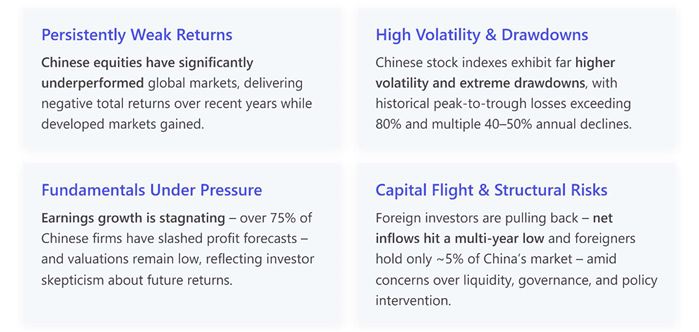
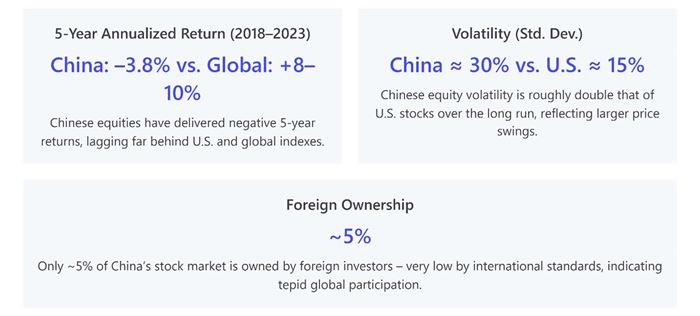
Chinese equity returns have been exceptionally weak compared to major markets. Over the last five years, the MSCI China Index produced negative annualized returns (~–3.8% per year, total –17.7%). In contrast, U.S. and global equities delivered strong gains – for example, from mid-2018 to mid-2023 the MSCI All-Country World Index (ACWI IMI) returned +8.6% annualized (over +50% in total), and the S&P 500 rose roughly +10% per year. This persistent underperformance means an investor in Chinese stocks has lost ground while peers in other markets enjoyed substantial appreciation.
- Dragging Down Emerging Markets: China’s slump has been so severe that excluding it actually boosted emerging-market returns. From mid-2018 to mid-2023, the MSCI Emerging Markets (EM) Index returned only +1.3% annually, but if China’s market was removed, EM returns would have been about +4.7% – a +3.4-percentage point higher annual return. China’s struggles effectively reduced EM index performance, highlighting how its weakness has been an outlier and a drag on broader At the global level, removing China modestly increased five-year returns as well (+0.6% annually).
- Poor Long-Term Risk/Reward: Even over decades, Chinese equities have offered scant reward for Since 1992, MSCI China’s compound annual growth rate is under 2%, while its standard deviation of returns is ~30%. The resulting Sharpe ratio is extremely low (~0.16), much worse than that of U.S. or global stocks (which have Sharpe ratios closer to 0.4–0.5 over long periods). In essence, investors in Chinese equities have borne extraordinary volatility for minimal returns.
2. High Volatility and Major Drawdowns
Chinese equity markets have experienced extreme volatility and crushing drawdowns that dwarf those of most other markets. Price swings are more pronounced due to a combination of speculative local trading, policy shocks, and structural risks. For instance, the long-run standard deviation of MSCI China’s returns is about 30% (and ~19% even in the latest 5-year period), versus roughly 15%–20% for U.S. or developed-market equities.
This means higher day-to-day and year-to-year volatility for Chinese stocks.
- Steep Annual Losses: Chinese stock indices have suffered multiple years of exceptionally large declines. MSCI China’s worst calendar year saw a –50% loss (1994) and it fell nearly –48% in Even in recent history, the Hang Seng Index plunged about –22% in a single quarter during 2022. These episodic crashes underscore the boom-bust nature of the market. By comparison, the U.S. S&P 500 Index’s worst year in modern times (2008) was –37%.
- Massive Drawdowns: The cumulative peak-to-trough declines in Chinese equities have been extraordinary. MSCI China endured a protracted drawdown of –87.3% from a 1993 peak to a 2015 trough (lasting over 21 years before fully recovering). Even more recently, Chinese stocks entered a bear market from early 2021 through late 2022, wiping out an estimated $7 trillion in market value across domestic and S.-listed Chinese companies. Such deep and lengthy slumps impose severe opportunity costs and test investor patience far more than typical developed-market cycles.
- Correlation in Crises: While Chinese stocks historically have shown some diversification benefits (often a low correlation with global markets), they have not proven to be safe havens during global selloffs. In fact, research finds Chinese equities slightly exacerbated losses in the 2008 global financial crisis (falling more than the EM average) and only modestly cushioned the initial COVID-19 drawdown. Thus, in periods of severe global stress, Chinese markets have tended to fall alongside or even amplify downturns rather than offset them.
3. Weak Earnings Growth and Downward Revisions
Fundamental corporate performance in China has disappointed expectations, contributing to poor equity returns. Economic headwinds and regulatory actions have weighed on earnings growth, leading analysts to cut profit forecasts en masse:
- Earnings Stagnation: Chinese firms’ profits have been flat or contracting recently. In the first half of 2023, aggregate corporate earnings actually fell by ~2.4% year-on-year. This contrasts with stronger earnings growth in many other markets post-pandemic. China’s post-COVID economic rebound has been underwhelming, hampering sales and margins. For example, consumer demand recovery has been slow, and sectors like property and tech have faced structural challenges, limiting profit expansion.
- Negative Revision Momentum: Analysts have persistently downgraded earnings estimates for Chinese Over 76% of onshore-listed firms cut their 2023 earnings outlook in mid-2023, with downgrades outnumbering upgrades by 3-to-1 in consensus data. Bank of America strategists warned that the entire market’s earnings forecasts might require further downward revisions given the challenging environment. This negative earnings momentum provides a quantitative indicator of deteriorating fundamentals, which often foreshadows lackluster stock performance.
- Policy Impacts on Profits: Part of the earnings weakness is attributable to policy interventions and regulatory crackdowns that have specifically targeted high-growth industries. For example, sweeping regulations on the internet/technology sector beginning in 2021 erased billions in market capitalization and curtailed earnings of dominant firms. Likewise, the real estate sector’s debt crisis (e.g. Evergrande’s default) has severely impacted financial stocks and construction-related companies’ earnings. These policy and macro shocks show up in reduced earnings and ultimately in stock
4. Low Valuations Reflecting Risk (“Value Trap”)
Chinese equities trade at deeply discounted valuation multiples relative to global peers, but this has not translated into superior returns – a classic potential “value trap.” The market’s low valuations are themselves a symptom of investor concern:
- Depressed Multiples: As of mid-2026, the aggregate price-to-earnings (P/E) ratio of the broad Chinese market is around 5. This is less than half the P/E of global equities (the MSCI All-World P/E is ~22.6) and far below U.S. market P/Es. While a low P/E often signals a bargain, in China’s case it likely reflects investors pricing in elevated risk and low growth expectations. Indeed, current P/E levels are in line with the bottom of China’s own 5-year historical range, indicating how bearish sentiment has become.
- Poor Returns per Valuation Unit: Historically, Chinese stocks’ realized returns have not kept up with even these modest valuations. For instance, despite periods of double-digit P/E ratios in the past, the long-term earnings yield (inverse of P/E) has not translated into commensurate equity returns, owing to frequent disruptions. Over 33 years, actual returns have been so low that most of the equity risk premium vanished, as evidenced by the low Sharpe ratio. This suggests valuations were not “cheap” enough given the underlying
- Caution on Re-Rating: The valuation gap alone is not enticing many investors – if anything, it underscores hesitation. Major asset managers have noted that without clearer catalysts or reforms, Chinese equities may remain cheap. For example, even after sharp declines, Chinese stocks’ forward P/E multiples continue to be slashed as earnings estimates fall, keeping the “E” in the P/E equation uncertain. Until corporate governance and policy outlook improve, investors worry that low valuations could persist or go even
5. Capital Outflows and Low Foreign Participation
Global investors have been reducing their exposure to Chinese stocks, both reflecting and reinforcing the market’s troubles:
- Foreign Outflows: International investors have pulled money from Chinese equities in record amounts during recent downturns. In October 2022, for example, foreigners withdrew about $7.9 billion via Stock Connect in a single month – the second-largest monthly outflow on record. More broadly, 2022 saw significant volatility in foreign flows; despite some buying spurts, sentiment soured by year-end. By 2023, foreign inflows had dwindled to just $6.1 billion for the entire year – the lowest annual foreign net investment since 2017. This indicates waning global appetite for Chinese equity risk.
- Minimal Foreign Ownership: Overseas investors still hold only ~5% of Chinese domestic equities by market cap, far below the 20–30% foreign ownership typical in many other emerging markets. While access has improved through programs like Stock Connect and MSCI index inclusion, China’s market remains predominantly driven by domestic investors. This dynamic can amplify volatility (as local investors often trade more speculatively) and means China is not deeply integrated into global portfolios. The limited foreign base also makes the market vulnerable if sentiment turns – a small group of foreign funds can significantly impact prices when they all rush for the exits or entries.
- Liquidity and Accessibility Concerns: Some investors are wary of liquidity constraints and potential capital controls in China. Although daily turnover in Shanghai and Shenzhen is high in absolute terms, accessibility issues remain. Capital mobility is still regulated – large, sudden outflows could be met with policy responses. For example, authorities maintain daily northbound flow quotas and could impose restrictions in extreme scenarios. This latent risk of reduced liquidity or capital controls makes some foreign investors cautious about committing large, long-term allocations to China’s onshore
6. Governance, Transparency, and Delisting Risks
Structural and regulatory risks unique to China’s markets further undermine investor confidence, as measurable through various indicators:
- Accounting & Transparency Issues: Chinese companies have faced repeated accounting controversies, which are reflected in regulatory penalties and investor A high-profile example was Luckin Coffee’s accounting fraud in 2019–2020, where the company fabricated sales; U.S. regulators subsequently fined Luckin $180 million for these violations. Such incidents, along with opaque corporate structures (e.g. the prevalent VIE structures for Chinese ADRs) and differing accounting standards, feed into quantitative risk metrics – e.g. higher required returns and lower P/E multiples for Chinese firms due to perceived governance risk. Global investor surveys and corporate governance indices have consistently rated Chinese companies lower on transparency and shareholder protections, which translates to a higher risk premium demanded by the market.
- Regulatory Uncertainty and Index Composition: The Chinese government’s active role in the economy introduces unpredictability for equity investors. For instance, sudden industry crackdowns (education, internet platforms) in 2021–2022 wiped out huge portions of those sectors’ market Such interventions are difficult to predict and model, adding an idiosyncratic risk factor to Chinese equities. Moreover, state-owned enterprises (SOEs) constitute a large share of Chinese indexes (many of the biggest A-share and H-share companies are banks, oil majors, telecoms, etc.), and these often prioritize government policy goals over minority shareholder returns. This skew in index composition towards SOEs has historically coincided with lower ROE and lower valuations, contributing to subpar index performance.
- S. Delisting Risk: Until recently, roughly 260 Chinese companies listed on U.S. exchanges (via ADRs) faced potential mandatory delisting by 2024 under the HFCAA (Holding Foreign Companies Accountable Act) if U.S. regulators were denied access to audit their books. While a late-2022 agreement on audit inspections has temporarily eased this risk, it remains a concern that could resurface if compliance falters. The mere prospect of forced ADR delistings introduced a quantifiable overhang: these stocks traded at wider discount spreads and higher volatility, reflecting the risk of being forced off U.S. markets. Some investors preemptively sold U.S.-listed Chinese shares or avoided them, contributing to lower liquidity and depressed valuations for several Chinese ADRs during 2021–2022.
In summary, the weight of quantitative evidence – poor historical returns, high volatility and drawdowns, meager earnings trends, declining capital flows, and structural risk factors – paints a cautionary picture for Chinese public equities at present. For investors focused on measurable risk/return attributes, Chinese stocks have offered lower returns and higher risk than other markets. Until these metrics show sustainable improvement (e.g. credible earnings growth, reduced policy uncertainty, improved transparency, and stabilization of capital flows), there are strong data-driven reasons to limit or avoid exposure to Chinese equities in favor of more stable and better-performing markets. The current environment suggests that Chinese markets are “cheap for a reason,” and prudent investors are demanding convincing evidence of a turnaround before re-entering in size. Each of the factors above underscores why many global investors remain on the sidelines when it comes to China’s stock markets, at least for now.
Emir Culov, MBA
Partner, Culov Wealth Management
Portfolio Management Director
Data sourced from: wsj.com, cepr.org, worldperatio.com, curvo.eu, gfmreview.com, scmp.com, The Economist, Washington Policy 1
Any opinions are those of Emir Culov and not necessarily those of Raymond James. Expressions of opinion are as of this date and are subject to change without notice. The information has been obtained from sources considered to be reliable, but we do not guarantee that the foregoing material is accurate or complete. Any information is not a complete summary or statement of all available data necessary for making an investment decision and does not constitute a recommendation.
Past performance may not be indicative of future results. Future investment performance cannot be guaranteed, investment yields will fluctuate with market conditions. Investing involves risk and you may incur a profit or loss regardless of strategy selected, including asset allocation and diversification. Every investor's situation is unique and you should consider your investment goals, risk tolerance and time horizon before making any investment. Prior to making an investment decision, please consult with your financial advisor about your individual situation.
The S&P 500 is an unmanaged index of 500 widely held stocks that is generally considered representative of the U.S. stock market. Keep in mind that individuals cannot invest directly in any index, and index performance does not include transaction costs or other fees, which will a ect actual investment performance. Individual investor's results will vary.
MSCI China Index: The MSCI China Index captures large and mid-cap representation across China H shares, B shares, Red chips and P chips. The index is based on the MSCI Global Investable Indexes (GIMI) Methodology. The index incorporates broad sector diversification, free float adjustment, minimum float, liquidity and size guidelines, annual and quarterly index reviews.
MSCI All Country World Index (ACWI): A free float-adjusted market capitalization weighted index designed to measure the equity market performance of developed and emerging markets. The index consists of 47 country indices comprising 23 developed and 24 emerging market countries. Developed markets are: Australia, Austria, Belgium, Canada, Denmark, Finland, France, Germany, Hong Kong, Ireland, Israel, Italy, Japan, Netherlands, New Zealand, Norway, Portugal, Singapore, Spain, Sweden, Switzerland, United Kingdom and United States. Emerging markets are: Brazil, Chile, China, Colombia, Czech Republic, Egypt, Greece, Hungary, India, Indonesia, Korea, Kuwait, Malaysia, Mexico, Peru, Philippines, Poland, Qatar, Saudi Arabia, South Africa, Taiwan, Thailand, Turkey and United Arab Emirates.
MSCI Emerging Market Index: A free float-adjusted market capitalization index that is designed to measure equity market performance of emerging markets. The index consists of the following 24 emerging market country indices: Brazil, Chile, China, Colombia, Czech Republic, Egypt, Greece, Hungary, India, Indonesia, Korea, Malaysia, Mexico, Peru, Philippines, Poland, Qatar, Saudi Arabia, South Africa, Taiwan, Thailand, Turkey and United Arab Emirates.
